Gender Balance Action Screen - November 2026
01.11.2026
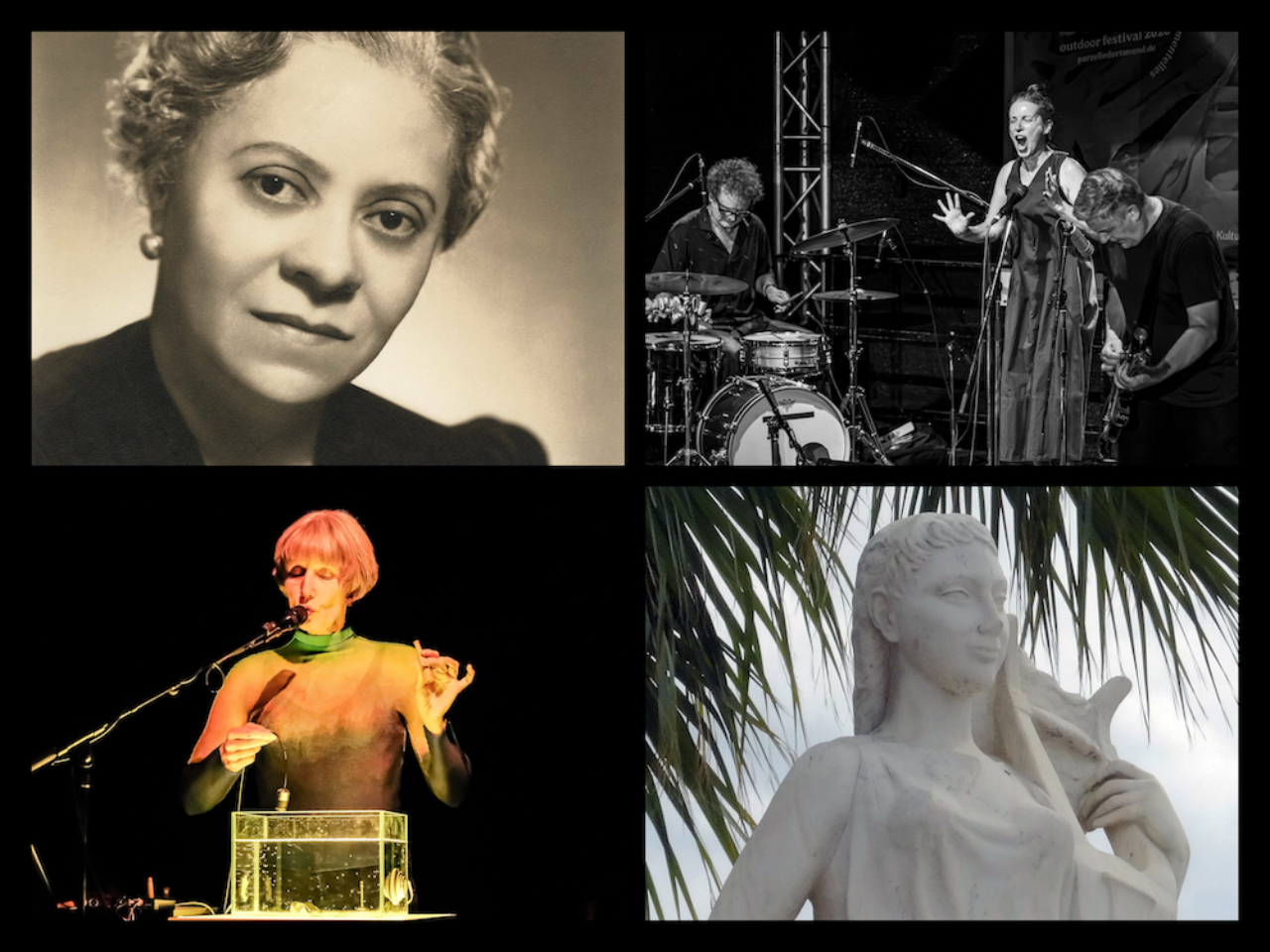
Unsere Dauerausstellung in der Cafeteria MAB mit wöchentlich wechselnden Portraits von Komponistinnen und Musikerinnen widmet sich im Oktober folgenden
Künstlerinnen:
2.11. Sappho
9.11. Isabelle Duthoit
16.11. Florence Price
23.11. Ute Wassermann
Die Arbeitsgruppe für Geschlechtergleichstellung ("Gender Balance Action Group“) hat sich im Nachgang zum Festival Feminale Basel 2025 gegründet und strebt eine stärkere Verankerung von weiblichem Musikschaffen im Repertoire der Lehre an.
Sappho (ca. 630–570 BCE), from the greek island of Lesbos, is one of the most celebrated musicians and poets of ancient Greece and was called the "Tenth Muse“ (Plato).
In ancient Greek mousikē, poetry, music, dance and ritual were closely intertwined. Sappho’s poems were lyrics, originally songs, performed to the accompaniment of the lyre, exploring Eros, longing, desire, pain, exile, the doorkeeper’s feet, chickpeas, and apple trees. She addressed the goddess Aphrodite as her ally in battle (súmmakhos).
Sappho shared and practised her art primarily within a circle of young women. According to the Suda she invented the plectron used to pluck the strings of the lyre and the pectis, an ancient lyre instrument (Deipnosophistai). Through the ancient theorist Aristoxenos (cited by Plutarch) it is said that she invented the ancient Mixolydian harmonia, associated with lament, passion and emotion, which was later adopted by the Greek tragediens. These are few surviving clues to the lost musical dimension of her work.
Her poetry survived only in fragments, sometimes reduced to broken lines, single words or sounds. Yet through countless translations, her voice has continued to resonate for more than 2500 years.
One particularly powerful translation is by Anne Carson.
Fragment [118]
yes! radiant lyre speak to me
become a voice
Isabelle Duthoit (* 6.12.1970 in Montargis) ist eine französische Jazz- und Improvisationsmusikerin, die Klarinette und eine einzigartige, vorsprachliche Gesangstechnik praktiziert.
Florence Beatrice Price (1887–1953) was an American composer and pianist, born in Little Roch, Arkansas. She later moved to Chicago, where she established herself as a composer. She wrote more than 300 works across a wide range of genres and became the first African American woman to have a symphony performed by a major American orchestra. A year later, she performed her own Piano Concerto in one Movement as a soloist with the Chicago Women’s Symphony Orchestra.
Price married the attorney Thomas J. Price, with whom she had two daughters and a son who died young. She composed the song To my little son in his memory. After experiencing domestic violence, she divorced her husband and raised her two daughters alone as a single mother. Throughout her career, she faced discrimination on both race and gender. She herself said: "I have two handicaps – those of sex and race."
In Thumbnail Sketches of a Day in the Life of a Washerwoman, Price turns her attention to the everyday life of a working-class woman. The opening movement Morning explores a rich chromatic language alongside pentatonic elements.
Ute Wassermann (*17.4.1960 in Gunzenhausen) ist eine in Berlin lebende Vokalistin, Komponistin und Klangkünstlerin. Ihr multidimensionaler Gesang oszilliert zwischen elektronischen, an/organischen, menschlichen und animalistischen Qualitäten. Zusätzlich verfremdet und erweitert sie ihre Stimme mit Vogel- und Gaumenpfeifen, Objekten, akustischen Kostümen oder verschiedenartigen Mikrofonen.